
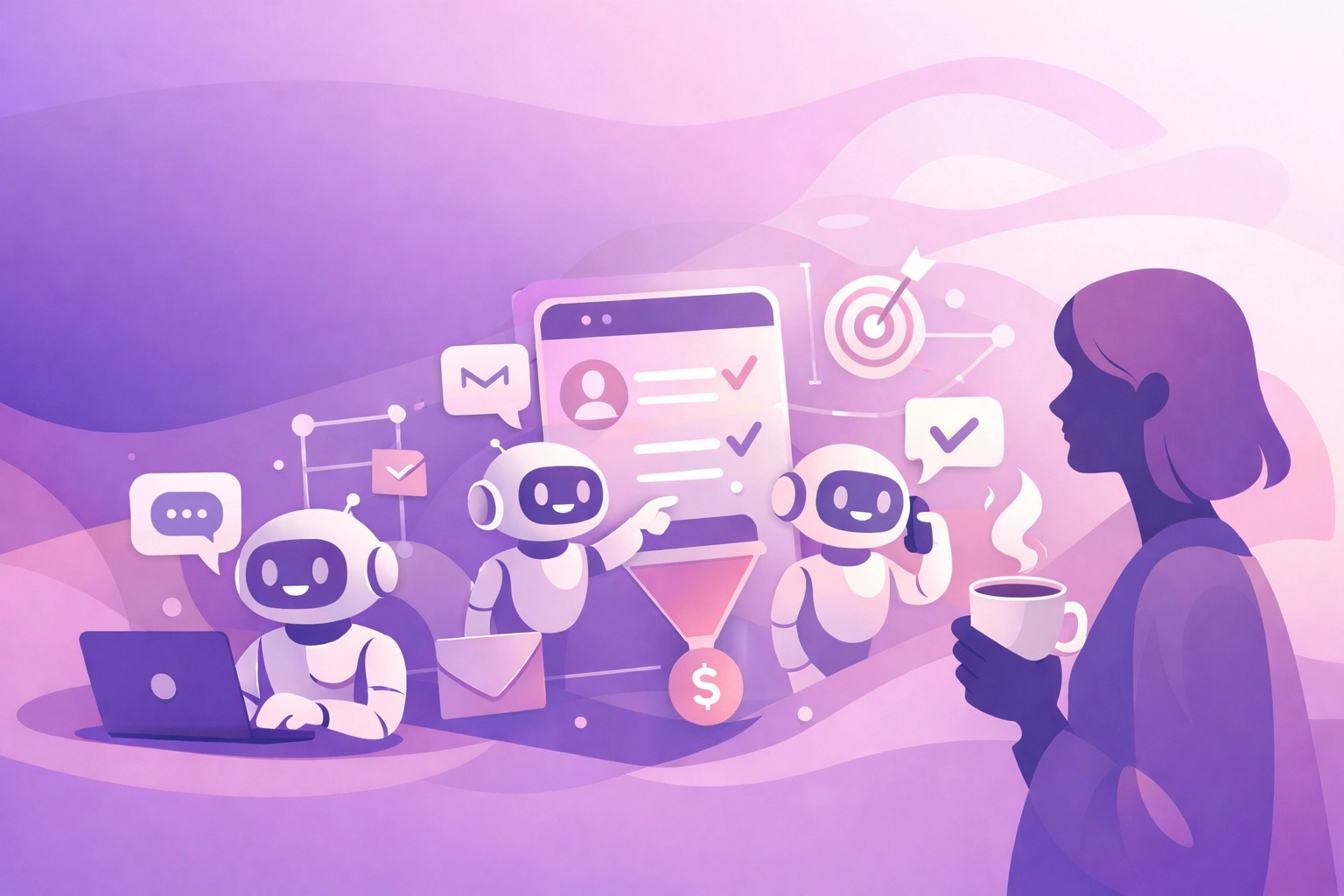
A potential client clicks on your ad, completes a form, and submits it. In a traditional business, that lead sits in an inbox for three hours. Perhaps three days. By the time someone calls them back, that prospect has forgotten why they reached out — or they've already signed with a competitor.
In a business powered by multi-agent AI workflows, the trajectory looks different. Before your team has reviewed the morning's submissions, an AI Call Agent has already dialed the lead, qualified them, addressed their objections, and potentially closed the sale.
This isn't simply about response speed. It represents a fundamental shift in how small and mid-sized businesses handle operations. At LumeH AI Consulting, we specialize in building these autonomous systems — helping businesses move beyond manual processes toward a model where technology handles the repetitive work.
The Economics of the 5-Minute Rule
Conversion rates often have less to do with brand strength than most business owners assume. The data tells a straightforward story: research from MIT found that responding within five minutes increases the likelihood of qualifying a lead by 21x compared to a thirty-minute delay. And 78% of customers end up buying from the company that responds first — not the most established, not the lowest price.
Most small businesses cannot sustain a five-minute response time. Teams are in meetings, serving existing customers, managing administrative tasks — not monitoring a screen for form submissions. After hours, expecting staff to field calls when they should be with family isn't realistic or sustainable.
That's where automation fills the gap — not by replacing your team, but by holding the line until they're available.
Anatomy of a Multi-Agent Workflow
"Multi-Agent AI" isn't a single chatbot answering questions on a website. It's an ecosystem of specialized AI agents passing tasks to one another — each with a distinct function, working in sequence.
Here's a workflow we frequently implement for clients:
Step 1: The Lead Capture
A prospect submits a lead form. This becomes the trigger. Rather than generating an email notification to a busy staff member, the form data routes instantly to an AI Call Agent.
Step 2: The AI Call Agent Responds
Within seconds, the Call Agent initiates a phone call. This isn't a robotic recording. It's a conversational agent equipped with specific instructions, using information from the form to personalize the interaction.
If the lead mentioned interest in a particular service, the agent acknowledges that context. It gathers additional information. It answers questions. It represents your company in real time.
Step 3: Handling Real-World Complexity
Phone calls rarely follow a script. Sometimes people don't answer. Sometimes the line is busy. Sometimes they're interested but the timing is wrong.
A properly designed workflow includes logic for every scenario.
No answer triggers a personalized voicemail and a scheduled follow-up.
Busy signal initiates a timed retry.
Request to call back later gets logged in the CRM with a specific time attached.

Step 4: Closing the Deal on the Spot
This is where the operational advantage becomes measurable. Through integrations and API connections, the AI agent can do more than qualify — it can transact.
If the prospect is ready to move forward, the agent can create a customer profile in your CRM, generate and send an invoice, process payment, and confirm the transaction. There's no "someone will send you a link later." The deal closes while interest is at its peak.
The Post-Call Intelligence Extraction
The workflow continues after the call ends. One of the challenges in busy sales environments is that detailed note-taking often falls by the wayside — not because staff are careless, but because they're juggling multiple priorities and moving to the next task.
Automation handles that documentation layer in the background. After each call, the system processes the transcript and extracts key information: pain points, sentiment, specific requirements, and objections raised. This creates a reliable record without adding to anyone's workload.

Step 5: The Task Agent and Compliance
A second agent — the Task Agent — takes over after data extraction. Its function is different: reviewing the call for compliance and data accuracy, ensuring the Call Agent followed legal guidelines and company policies.
If the call didn't result in a close, the Task Agent generates an internal summary for your team. Not a raw transcript, but a strategic brief explaining what the prospect needs and why they haven't committed.
Step 6: The Contextual Follow-Up
Finally, the Task Agent sends an intelligent follow-up email to the lead. This isn't a templated "thanks for your interest" message. It references specific details from the conversation — information they requested, next steps discussed, questions that were raised.
By the time your staff reviews the dashboard, they aren't looking at a cold lead. They're looking at a fully qualified prospect with complete documentation and a pre-scheduled next action.
Accessibility for Small and Mid-Sized Business
There's a common assumption that this level of sophistication requires enterprise resources. That assumption is outdated. Because these systems rely on API integrations and increasingly accessible platforms, the barrier to implementation has dropped significantly.
At LumeH, we focus on making these tools practical for businesses without dedicated development teams. What's required isn't technical staff — it's a well-designed workflow and the consulting support to configure it properly.
The competitive advantage is substantial. You're no longer competing on price or legacy alone. You're competing on responsiveness and professionalism. When you're the first to call, and that call is helpful and efficient, trust is established before the prospect has time to consider alternatives.
Beyond Lead Response: Workflow Applications
The lead conversion example above represents one application. The modular nature of multi-agent AI means the architecture adapts to different operational needs.
Inventory monitoring that automatically reaches out to past customers when a product they purchased is back in stock. Complex scheduling across multiple time zones without human coordination. Candidate screening that conducts initial interviews and surfaces only the most qualified applicants to hiring managers.
The constraint isn't technical capability. It's imagination — and clarity about where automation delivers the most value for a specific business.
The Human Element
A reasonable concern: will customers resent interacting with AI?
The evidence suggests customers resent waiting. They resent repeating themselves across multiple touchpoints. They resent being told someone will return their call in 48 hours.
A well-designed AI agent functions like a high-end concierge — immediate answers, immediate action. When situations exceed the agent's scope, it hands off seamlessly to a human team member with full context intact. This isn't about replacement. It's about freeing people to focus on work that genuinely requires human judgment, empathy, and complex problem-solving.
Starting Point
Implementing a multi-agent workflow doesn't require automating an entire operation overnight. The practical approach is identifying the most significant bottleneck — lead response, appointment scheduling, customer support — and building from there.
The five-minute window is real. Leads are arriving. The question is whether the systems are in place to engage them before they move on.
Ready to explore how this applies to your business? Contact LumeH to discuss your specific operational challenges. No hype — just practical solutions.